



Around the 20th century, when footprints of the Third Industrial Revolution were taking shape in the sands of time, technological experts predicted doom for Africa. According to them, the continent – especially sub-Saharan Africa will be cut off from the rest of the world – which will be galvanized by technology and the internet.
The reason behind these widely promoted and accepted projections was simple – experts believe it would be impossible for African nations to transition quickly enough with the rest of the world in the adoption of digital internet connection.
They cited the issues with infrastructure and the need for a structured system of the public switched telephone network (otherwise known as PSTN). To the average analyst, how can a continent that could not successfully distribute landline telephone networks through single telephony exchanges fit into a more sophisticated digital era?
With a lack of digital communication – which was the bedrock of the third industrial revolution – and would lead to future industrial revolutions, it was projected that sub-Saharan Africa would fall further behind. But how wrong they were.
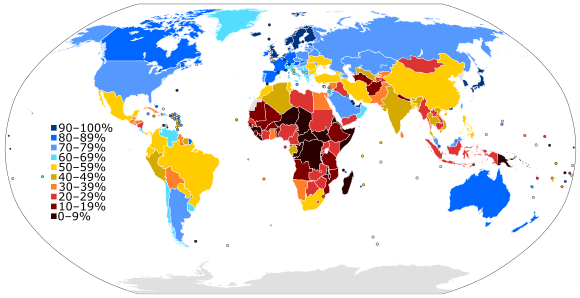
According to Statista, as of January 2022, Morocco had an internet penetration ratio of 84.1%, Seychelles 79%, Egypt 71.9%, South Africa 68.2%, and 13 other African countries ranking above 50%. The figures have increased since then and continue on an upward curve.
Today, official reports released by the World Bank confirm those issued by the African Development Bank (ADB) that there are over 650 million active mobile users in Africa – this is more than the number in the U.S. and Europe. Also, within two decades, the continent boasts of some of the best technology and internet infrastructure that can match those obtainable anywhere in the world.
In fact, there are infamous reports that reveal that in some countries across Africa, more people have access to smartphones than they do to electricity, a bank account, or even clean water.
The Third Industrial Revolution, which is also known as the Age of the Digital Revolution relates to the digitization and automation of the world through computers and electronics. It involves the evolution of communication and how it further unites the world into one global village. Those who, however, projected that the African continent would fall behind are left with no options but to eat their words.
In a recent interview, Sudanese billionaire and philanthropist Mo Ibrahim revealed that when he sold Celtel for $3.4 billion in 2005, the telecommunications company already had an excess of 20 million subscribers. He added that contrary to global projections, technology gave Africa leverage to catch up with Europe, America, and Asia.
It took two years after the design of the first smartphone by IBM in 1993 for Africa to have a permanent internet connection.
Europe, Asia, and America were already exposed to smartphones with touchscreens and multiple functions before Ghana – the first country in West Africa to get stable internet connection on 21 August 1995.
Dr. Nii Quaynor is credited for pioneering internet development and expansion across Africa for about two decades. He established some of Africa’s first internet connections and was instrumental in setting up key organizations, like the African Network Operators Group.
According to 2022 statistics released by the World Bank, in what appears to have dwarfed global projections the most, Sub-Saharan Africa currently records the highest growth in global Internet penetration. Reports reveal that it increased from less than 1% in 2000 to 30% in 2022. Also, between 2019 and 2021 only, internet use in Africa increased by 23%.
However, it is essential to note that there is still a lot of ground to cover. One major challenge facing millions across the continent is access to reliable and affordable internet access.
Despite the commendable growth, millions of Africans still require assistance accessing the internet and internet services.